 New York Drain Cleaner
Call 24/7 · (844) 923-3233
Drain Cleaning Services in Brooklyn, NY
Need drain cleaning services in Brooklyn, NY? One call connects you with a local crew. Brooklyn’s buildings span more than a century and a half of plumbing. Brownstones and rowhouses with house traps, pre-war apartment buildings with shared stacks, two- and three-family houses, post-war semi-detached homes and converted industrial lofts all sit within a few miles of each other. We connect you with independent local crews who know which building they are walking into.
Shared buildings, one trap
In a two-family or small apartment building, one house trap typically serves every unit. When it clogs, all households notice. Let neighbours know before the technician arrives so nobody runs a washer or a shower during the work. Coordinating water use keeps the cellar drier and the job shorter.
Afterward, residents can return to normal use. A quick check of the cellar drain an hour later confirms the line is holding.
In buildings with several households, one person should be the contact for the technician. That keeps instructions clear and the work moving.
Drain cleaning services in Brooklyn
Service area ZIP codes: 11201, 11203, 11204, 11205, 11206, 11207, 11208, 11209, 11210, 11211, 11212, 11213, 11214, 11215, 11216, 11217, 11218, 11219, 11220, 11221, 11222, 11223, 11224, 11225, 11226, 11228, 11229, 11230, 11231, 11232, 11233, 11234, 11235, 11236, 11237, 11238, 11239, 11241, 11242, 11243, 11249, 11252, 11256.
Brooklyn districts
Brownstone blocks and what runs under them
Brooklyn's older rowhouse streets, from Park Slope to Bedford-Stuyvesant, were built with the cellar drain and its trap close to the front wall, and many still depend on a line laid more than a century ago. When the whole house backs up from the lowest floor, that front-wall trap is where a crew usually starts.
Converted two- and three-family houses add another layer: a clog in the garden flat can begin with a kitchen two floors up. Say which floors are affected and which are not.
A borough of buildings
Drain trouble in Brooklyn depends on the building more than the street. A four-storey brownstone with a rented garden floor, a pre-war elevator building with sixty apartments, a three-family frame house and a one-storey commercial kitchen each call for a different crew, a different machine and a different set of questions.
We describe drains by building age, building type, pipe material, access and equipment, because those decide the job. Each district page applies the same lens to its own streets.
Brownstones, rowhouses and house traps
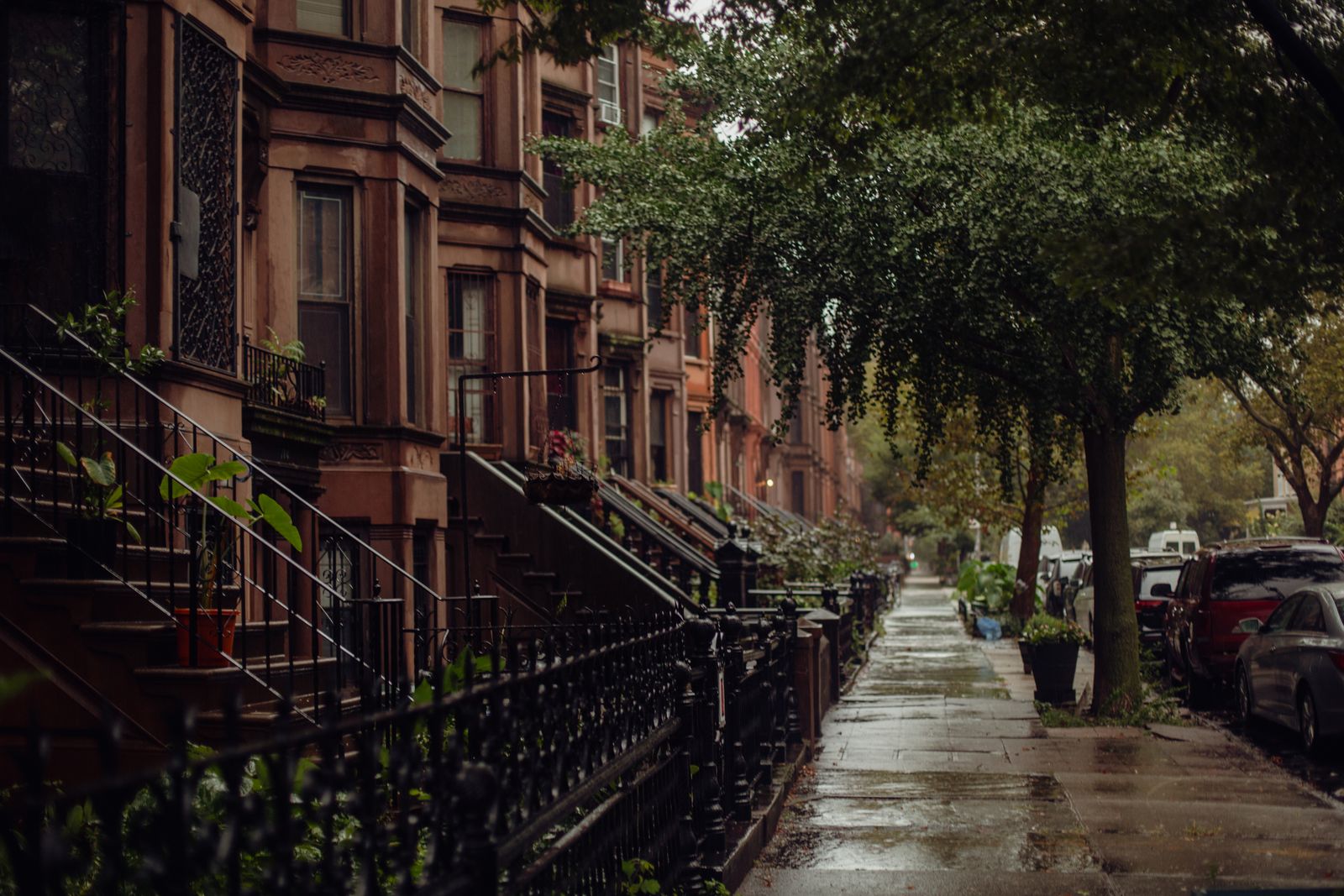
Brooklyn has long blocks of brownstones, limestones and brick rowhouses built from the middle of the nineteenth century onward. Many have a house trap, a U-shaped bend in the building drain in the cellar, usually near the front wall, with two round cleanout plugs on top. When it clogs, every fixture in the house backs up, and the cellar drain shows it first.
Outside, near the stoop, you may see a short vent pipe or grate. That is the fresh-air inlet. Please do not open the trap plugs yourself; if the line is full, the trap is holding back everything above it.
Shared walls, shared lines
Rowhouses sit shoulder to shoulder, and in some blocks laterals and even branch lines run close together. A slow drain next door is not always next door’s problem. A camera shows where your own line ends and what is happening in it.
If you rent in a brownstone, tell the owner or the managing agent before calling. They know the cellar, the keys and the history of the building.
Pre-war apartment buildings and shared stacks
Brooklyn’s pre-war apartment buildings and co-ops carry waste through large vertical stacks shared by every unit on the line. A clog in your branch affects you. A clog in the stack affects everyone below, and the lowest unit sees it first.
The super or the managing agent controls access to the cellar, the riser closets and the cleanouts. Call them first. We then connect you with a crew that works buildings like yours.
Two- and three-family houses
Wooden and brick two- and three-family houses fill much of the borough. The floors share one building drain. A clog in the lower flat usually has its cause upstairs or in the cellar line. The owner often lives in the building and arranges the call.
Tell us which flat you are in, who lives above, and whether the cellar is finished. It tells the crew where to start.
Post-war and outer-borough housing
Farther from the waterfront, the housing changes: semi-detached brick houses, post-war attached rows, mid-century apartment complexes and detached houses on small lots. Drains are often cast iron or clay, with plastic in renovated sections.
Roots from street trees reach laterals in the leafier neighbourhoods. A camera shows entry points and the condition of the pipe.
Pipe materials and what they do
Older Brooklyn buildings have cast iron stacks and building drains, some with lead and oakum joints, and brass or galvanised branch lines. Scale builds inside the iron over decades. Renovations add copper and plastic, joined to the old pipe at transition points that are common trouble spots.
A technician who knows the materials chooses the cable head and the pressure to suit. On old iron, jetting is used only when a camera shows the pipe can take it.
Cellars, keys and access
Brooklyn cellars are often cramped, shared or locked. A crew needs to know who has the key, where the cleanout or the trap is, and how a machine gets down the stairs. Narrow streets and parking rules matter too.
Tell us about the layout and about parking when you call. It saves time on arrival.
Restaurants, bakeries and commercial kitchens
Brooklyn has food businesses on nearly every commercial avenue. Grease, food solids and heavy dish-machine flows strain old lines. Scheduled cleaning usually costs less than a closed kitchen on a Friday night.
The technician clears lines and does not service grease interceptors. Tell us the business type and when the crew can have access.
Heavy rain, low ground and basements
Heavy rain can load older sewers and low-lying blocks, and cellar floor drains show it first. A technician can make sure your own line is clear so it is not part of the problem. No one can promise that cleaning prevents storm-related backups.
If backups follow every storm, ask about a camera inspection and about backwater valves, which the technician can advise on.
Reading your block: three quick clues
You can often tell what you have before the crew arrives. If the block is a long row of tall, narrow houses with stoops, expect iron drains and, in many, a house trap in the cellar. If the building is a six- to ten-storey elevator building, expect a shared stack and a super. If it is a detached or semi-detached house on a leafy street, expect a long lateral and roots.
Look at the cellar floor. A drain grate in the floor, two round plugs on the main pipe, or a capped cleanout tell the crew a great deal. A photo of any of them, texted or described on the call, saves time.
If you cannot find any of these, that is also useful information.
Brownstone Brooklyn, in more detail
Downtown, Brooklyn Heights, Cobble Hill, Boerum Hill, Carroll Gardens, Park Slope, Fort Greene, Clinton Hill and Prospect Heights are the heartland of the borough’s rowhouse stock. Most were converted from single-family houses to duplexes or three or four flats, adding kitchens and bathrooms to a plumbing system laid out for one household.
Added fixtures meant added branch lines tied into the original drain, often with tight bends. Grease and paper catch in those bends. The pattern repeats from house to house, and a crew that has cleared one can usually predict the next.
See the Downtown & Brownstone Brooklyn page for the details.
Williamsburg to Bushwick: wood, brick and conversion
North Brooklyn’s wooden and brick walk-ups sit beside converted factories and new mid-rise buildings. Stack-sharing in walk-ups and long horizontal runs in lofts are the two patterns that matter most.
Repeat clogs in lofts are often a slope problem, not a habit problem, and a camera shows it.
See the Williamsburg, Greenpoint & Bushwick page.
Bedford-Stuyvesant, Crown Heights and Brownsville
Central Brooklyn has long intact blocks of nineteenth-century rowhouses, large pre-war apartment buildings along the parkways, and low-rise blocks of two- and three-family houses. House traps and iron scale are the common findings.
Mature trees close to older laterals add roots to the list.
See the Bedford-Stuyvesant, Crown Heights & Brownsville page.
Southeast and south-central Brooklyn
East New York, Canarsie and the neighbourhoods toward Jamaica Bay have attached and semi-detached two-family houses on low ground. Flatbush, Midwood and Sheepshead Bay have larger detached and semi-detached houses under big trees.
Finished cellars, sump pumps and storms matter in the first group. Roots and old clay matter in the second.
See the East New York & Canarsie and the Flatbush pages.
South and west Brooklyn
Sunset Park, Bay Ridge, Bensonhurst, Borough Park, Gravesend and Coney Island are dense with attached brick houses, two-family homes and apartment buildings, along busy commercial avenues and down to a low waterfront.
Added cellar kitchens, long laterals on slopes and food businesses are the common themes.
See the South Brooklyn page.
Building age, in rough terms
Pre-1900 buildings usually have original or heavily patched iron drains. Buildings from 1900 to 1940 have cast iron stacks and house traps. Buildings from 1940 to 1970 have iron or early copper and plastic. Buildings after 1980 have plastic stacks and modern fixtures.
These are tendencies, not rules. Renovations mix everything. A camera cuts through the guesswork.
Tell the technician what you know.
Rentals, owners and shared responsibility
In a rented flat, the owner or managing agent decides who is called. In a co-op, the proprietary lease and the board set the rules. In a condominium, the unit owner generally owns plumbing inside the unit and the association owns common stacks.
We do not advise on who owes what. We give you a clear explanation of what the technician found.
Tell us your situation when you call.
Stoops, cellar doors and where the crew can park
Access in Brooklyn is a practical question. Many brownstone cellars are reached by a door under the stoop, a gate in a basement areaway, or an interior stair that is narrow and steep. Machines have to be carried, not wheeled, and a jetter truck needs somewhere legal to stop.
Tell the dispatcher how the crew gets to the cellar, whether there is an areaway gate, and whether alternate-side parking or a loading zone is in effect. A short note saves the crew twenty minutes and spares the neighbours a blocked street.
If a doorman or a key holder controls the cellar, give their name and number.
Repeat clogs and the camera
A house that clogs more than twice in a year is telling you something. A camera pass shows whether it is scale, roots, a sag or a joint, and each of those needs a different answer.
Without the footage, repeated cleaning is a guess.
Signs of a grease buildup
A kitchen sink that drains slower each month, a greasy smell and a gurgle from the basement drain suggest a grease buildup. The fat coats the wall and narrows the line.
A jetting pass scours it, and a change of habits slows its return.
Telling the dispatcher about access
Say whether the cleanout is in the cellar, the yard or an areaway, and whether the door is locked. Tell the crew about steps, a low ceiling and a tight passage.
A call that covers access saves a second trip.
Do not reach for chemicals
Liquid openers rarely clear a main and can sit in the pipe, which makes a later visit riskier for the crew. If a plunger does not help within a few tries, call and say what you tried.
Kitchen stacks in older buildings
Kitchen drains in older buildings often share a separate stack, and grease from many households collects there. Clogs in kitchen stacks tend to affect the same line of apartments floor by floor. Clearing the stack restores flow, and building-wide reminders about grease help prevent repeats.
Periodic cleaning of kitchen stacks is a common step for older buildings with frequent grease clogs.
Regular reminders to residents about grease and wipes are one of the lowest-cost ways to reduce stack clogs.
A branch or the main
A slow sink with clear neighbors points to a branch. When the garden flat backs up while the upper floors are fine, the main is the likely cause. That difference decides where the cable goes in.
Say which floors are affected and which are not.
What to avoid with roots
Do not pour rock salt or copper products into a line to kill roots. They can harm the pipe and rarely solve the cause. A camera shows where the roots enter, and a cutter or a spot repair is the lasting fix.
Water on the laundry floor
If water spreads across the laundry floor when the machine empties, stop it and tell the dispatcher. The standpipe or the floor drain cannot take the burst, and the main is likely narrowed.
Sewer gas indoors
A sewer smell in a bathroom or the cellar often means a dry trap. Pour a pitcher of water into the drain. If the smell stays, the cause may be a vent, a cracked fitting or a partly open line, and a technician should look.
How a Brooklyn call is matched
Give your neighborhood and the type of building, say which fixtures are affected and whether the super knows. The dispatcher matches you with an independent crew that works near you.
The crew we connect you with gives you the price before work begins, and there are no hidden fees.
Camera findings on Brooklyn lines
Findings include scale in iron, grease in kitchen branches, roots under street trees, offset joints where old pipe meets new and sags where settlement bent a long run. The camera also shows the condition of a house trap.
Ask for the footage and keep it.
Cold snaps and exposed pipe
Brooklyn winters are mild next to upstate, but hard freezes can close exposed drains in unheated cellars and garages. A frozen drain looks like a clog. Tell the dispatcher the temperature pattern.
Brooklyn drain questions
Should a Brooklyn tenant call the super first?
Yes, in a managed building. The super knows the stack and the cleanouts and can approve an outside crew.
Why does my cellar drain back up first?
It is the lowest opening. When the main or the house trap is blocked, water from upstairs has nowhere to go but out of the lowest point.
Do Brooklyn rowhouses on one block share a drain?
Usually each house has its own line to the street, although old arrangements exist. A camera shows where a line goes.
How can I tell if one Brooklyn fixture is clogged, not the main?
If only one fixture is slow and the others are fine, it is likely the branch.
What diameter is a Brooklyn rowhouse main?
Houses often have a four-inch main, though older ones may be different. The camera and the crew can measure it.
What does a camera miss in a Brooklyn line?
It cannot see through standing water or a full blockage, so the crew clears the line first.
Are Brooklyn roots worse in spring and summer?
They grow fastest in the warm months, so a slow drain often appears then.
Why would a Brooklyn kitchen sink smell even when it drains?
Grease and food scraps on the pipe wall rot, or a trap has dried out. A cleaning and water in the trap help.
Can a Brooklyn laundry overflow point to the main?
Yes. If the standpipe or floor drain overflows while the machine empties, the main may be narrowed.
Can a Brooklyn owner have a cleanout added?
Often, yes. A technician can say whether one can be fitted and what it would involve.
Around Brooklyn
- Flatbush, Midwood & Sheepshead Bay
- East New York, Canarsie & Southeast Brooklyn
- Bedford-Stuyvesant, Crown Heights & Brownsville
- Downtown & Brownstone Brooklyn